Pillar guide · 14 min read
How to resell GoHighLevel: three models, one decision
There are three ways to make money reselling GoHighLevel, and they are not variations on one business. They are three different businesses with three different licences, three different margins and three different things that break. Pick the wrong one for where you are, and you spend a year supporting software you cannot support. Here is how each one actually pays.
Marcus Feld
Head of Build
Published
Somebody told you there is money in reselling GoHighLevel, and they were right. What they probably did not tell you is that "reselling GoHighLevel" is not one thing. It is three businesses that happen to share a logo, and the person who made it work for them was almost certainly describing one of the three while you were imagining another. One of them sells software. One sells a finished account. One sells your own time, repackaged. They earn their margin in different places, they need different rights to be legal, and they break in different ways at two in the morning.
This is the guide to picking the right one for where your agency actually is, not where a case study says it should be. It is written for the principal who already resells something and is deciding how to resell more of it, so there is no section explaining what a sub-account is. Every figure in it is sourced or marked as an assumption you can replace, and the only honest promise is that by the end you will know which of the three you are being sold whenever somebody says the word.
The three models, and why they are not the same job
Start by naming them plainly, because the confusion is the whole problem. When an agency says it resells GoHighLevel it means one of these, and often does not realise there is a choice.
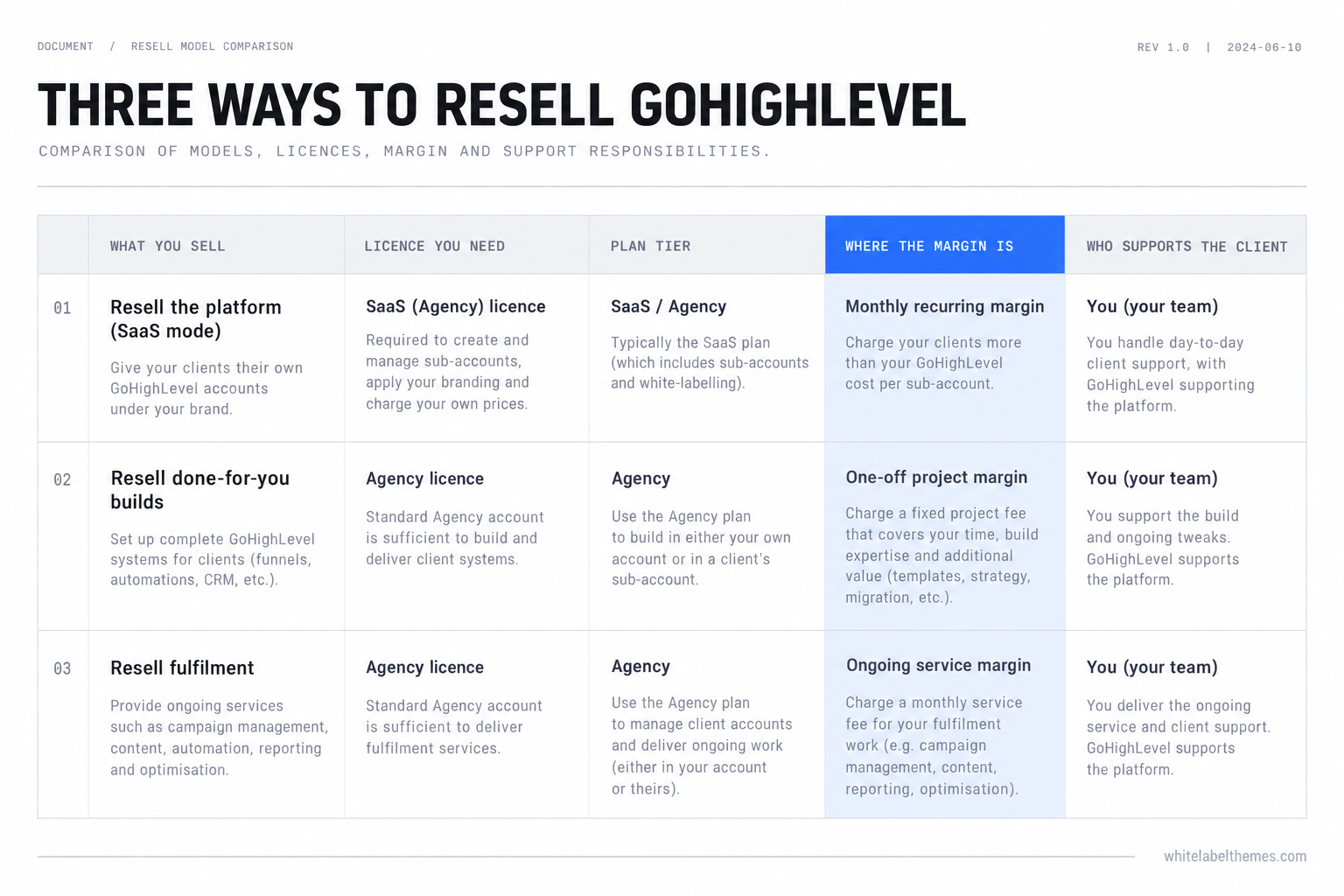
The first is reselling the platform. You turn on SaaS mode, rebrand the software as your own, and sell logins to end businesses who pay you a monthly fee to use a tool they think you built. The second is reselling done-for-you builds: you take a configured account, put your name on it, and sell it to a client as a finished system plus a setup fee. The third is reselling fulfilment: you keep selling the managed service but hand the actual delivery labour to somebody else under your brand. These map onto the older distinction between white label and reseller, but they are sharper than that, because each one answers a different question about what your client is paying for.
The platform model sells access. The build model sells an outcome that arrives in a box. The fulfilment model sells your continued attention without your continued hours. A client on the first is buying software from you. A client on the second is buying a system from you. A client on the third is buying you, except it is not you doing the work. Those are not three price points on one menu. They are three companies, and most agencies that struggle with GoHighLevel are quietly running two of them at once without having decided to.
Model one: reselling the platform itself
This is the one people mean when they say the word with a gleam in their eye. You become a software company. SaaS mode lets you present GoHighLevel as your own product, set your own prices, let clients sign themselves up with a card, and rebill their usage with a markup on top. It is recurring software revenue, which is the best kind of revenue there is, and the pitch writes itself. The pitch is also where most of the honesty leaks out.
The first fact is a plan tier. SaaS mode lives on the top plan. HighLevel publishes three agency plans, Starter at $97 a month, Unlimited at $297, and Agency Pro at $497 (gohighlevel.com/pricing, confirmed via search snippet this run rather than independently fetched, because the pricing page would not load from here), and SaaS mode and its rebilling only exist on that $497 tier. So the software business starts with a fixed $497 a month going out of the door before a single seat is sold. The deeper mechanics of making that number back are their own subject, covered in pricing a SaaS mode plan that survives usage, and the short version is that usage is where unprepared resellers lose the margin they thought the plan fee was protecting.
The second fact is the one nobody puts on the sales slide: when you resell the platform, you become the support desk. The client signed up for your software, so when a workflow does not fire or a form will not embed, they do not open a HighLevel ticket. They open a ticket with you, because as far as they know HighLevel does not exist. You have sold yourself a software support obligation that runs for as long as the client pays, and software support is a job, not a passive royalty. This is why the model that looks the most like easy money is the one that quietly consumes the most of your week.
Here is the arithmetic that the gleam leaves out. Say you get to ten paying seats at $97 a month each, which is a real milestone that takes most agencies months. That is $970 of recurring revenue. The Agency Pro plan takes $497 of it immediately. If you are sensible you are not answering every one of those support tickets yourself, so you resell a white-label support desk underneath you: HL Pro Tools publishes a VIP tier at $397 a month covering up to ten clients and an Elite tier at $997 a month for unlimited (go.hlprotools.com, confirmed via search snippet this run). Put the VIP desk under your ten seats and your $970 becomes $76 a month before you have rebilled a single text message.
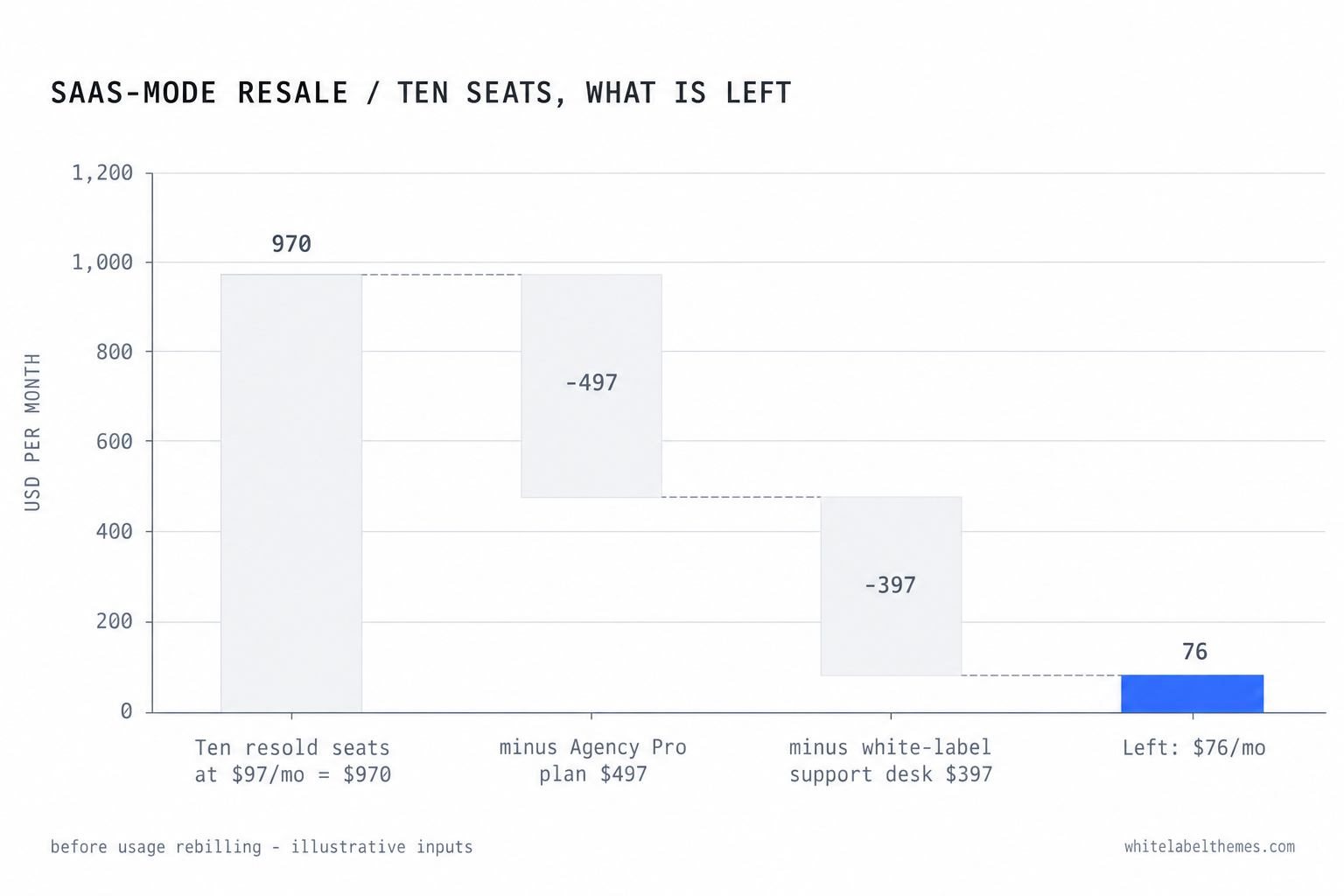
That $76 is not the verdict on the model. It is the warning on the model. The platform business does make money, but it makes it in two places the plate above does not show: on usage rebilling, where you mark up the client’s texts, emails and AI minutes, and on volume far beyond ten, where the $497 plan fee is spread across so many seats it stops mattering. What the plate shows is that the subscription spread alone will not carry you, and that the support desk is not optional overhead, it is the cost of the obligation you took on the moment you told a client the software was yours.
Model two: reselling a done-for-you build
This is the model most agencies should start with, and the one they skip because it looks less glamorous than owning software. You take a complete, configured GoHighLevel account, the funnels and pipelines and workflows and reminder sequences, you put your branding on it, and you sell it to a client as a finished system. The client pays a one-time setup fee to be stood up, and a monthly retainer to keep it running. You are not renting them software. You are handing them a working business system with your name on the door.
The build you sell comes from one of two places: you make it yourself, once, and reuse it, or you buy it as a white-label snapshot and reuse that. Which of those is right is a real decision with a real wrong answer, worked through in buy or build a GoHighLevel snapshot, and the figure most people leave out of the build side is the copy pass and a year of maintenance. For this guide the point is narrower: whichever way you source it, the resale economics are the same, and they are good.
Walk one deal. You buy an HVAC snapshot for $1,275, which is a real price from our own catalogue read this run, not a figure from memory. You resell it to a contractor with a $2,500 setup fee and a $1,200 monthly retainer. Those two numbers are assumptions, and yours will differ, but the shape is what to copy. Year one brings in the setup fee plus twelve months of retainer, which is $2,500 plus $14,400, so $16,900 from one client.
| Line in a first-year resale deal | Amount | Running total |
|---|---|---|
| Setup fee plus twelve months of retainer | $16,900 | $16,900 |
| Snapshot, bought once (reused for every client after) | minus $1,275 | $15,625 |
| Rebrand and import, about ten hours at $75 | minus $750 | $14,875 |
| Platform, one sub-account allocated from your Unlimited plan | minus $720 | $14,155 |
| Ongoing delivery, three hours a month at $75 | minus $2,700 | $11,455 |
| Tools and integrations allocated to the account | minus $480 | $10,975 |
| First-year gross margin on one client | $10,975 | about 65% |
Two things make that work, and both repeat. The snapshot is a one-time cost on the first client and free on every client after, because a build you own the resale rights to installs into as many sub-accounts as you have clients. So the $1,275 line vanishes from deal two onward and the margin climbs. And the setup fee is doing its real job, which is paying for the stand-up work so the retainer can be close to pure margin.
An agency that waives the setup fee to win a deal has agreed to fund the client’s onboarding out of its own pocket, repaid slowly and interest-free by a retainer that might churn before it catches up. How to size that fee so it pays for the build week and not merely for the file is worked through in what to charge a client for a snapshot install, and it is the single number that decides whether this model is a business or a hobby.
Model three: reselling fulfilment
The third model is the one agencies back into when the second one works too well. You have sold builds and retainers, the book is growing, and the thing that is now stopping you is not sales. It is that every client you add is more delivery hours, and the hours are yours, and you have run out of them. Reselling fulfilment is the decision to keep selling the managed service while handing the delivery labour to someone else, under your brand, so the client never knows the hands changed.
This is not the same as reselling a build. A build is a thing you ship once. Fulfilment is the ongoing work of running the account afterwards: the monthly reporting, the tweaks, the support, the new automation the client asked for in week nine. You can resell that in two ways. You can put a white-label support desk under the reactive side of it, or you can hand the whole delivery to a white-label fulfilment retainer that runs the accounts as your team. The trade is always the same: you give up margin per client in exchange for the hours back, and whether that trade is worth it depends entirely on what the hours were otherwise going to cost you.
The arithmetic is a subtraction, not a multiplication. Say you charge a client $2,500 a month for a managed service. If you deliver it yourself, your cost is your time, and your time has a ceiling you have probably already hit. If you subcontract the delivery to a fixed monthly fulfilment line, your cost becomes that line and your margin becomes the difference. Charge $2,500, subcontract delivery at a fixed $1,850, and you keep $650 a month per client at roughly twenty-six per cent, having done almost none of the work. That is a worse percentage than delivering it yourself and a better business, because it is a percentage you can repeat forty times without running out of Tuesdays.
The reason this model exists at all is the ceiling the other two eventually hit. An agency delivering everything in-house grows until delivery becomes the constraint, and then it stops, because the founder is the bottleneck and the founder cannot be cloned. That wall, and the three things that break as you approach it, is the whole subject of how to deliver GoHighLevel to clients without losing the month. Fulfilment resale is one of the levers for getting through it, and it is the one that costs margin rather than cash, which makes it the right lever precisely when cash is the thing you are short of.
The licence is the part that ends the business
Every one of the three models rests on a right, and the right is easier to get wrong than the margin. Margin that is wrong costs you money. A licence that is wrong costs you the client, retroactively, on a day you did not choose.
For the build model the right you need is specific, and it is not "can I use this snapshot". It is: may I install this into unlimited sub-accounts inside my own agency, and does my client’s account keep working if the seller disappears. A snapshot that installs only from the seller’s live link is a snapshot that stops being yours the day the seller turns the link off, and your client’s system goes with it. The full set of questions to ask a seller in writing, before money changes hands, is laid out in GHL snapshot licensing and what you may resell, and it is the one piece of reading on this page that is not optional.
For the platform model the right is HighLevel’s to grant, and it comes with the plan. SaaS mode on the Agency Pro tier is the licence to present the software as your own, and it is why the model cannot be run on a cheaper plan however clever you are. For the fulfilment model the right is contractual: whoever delivers under your brand must be bound not to contact your client, not to publish your client as a case study, and not to appear anywhere in the account. A fulfilment partner who reserves any of those rights has sold you a reseller arrangement wearing white-label clothes, which is the exact thing your client is paying you to make impossible.
Four ways a resale business breaks
These are the failures that recur, written as symptom, cause and fix, because a resale model does not usually die of a bad idea. It dies of a right thing done in the wrong order.
You resell the platform before you can support it
The symptom is a second month worse than the first: sign-ups slow, tickets pile up, and the seats you did sell start cancelling. The cause is that you sold software support you were not staffed to give, so clients who could not get a workflow working concluded your product was broken and left. The fix is order. Do not open SaaS mode until a support desk is already under you and you have run a handful of seats through it long enough to know what breaks. The platform model is a support business with a subscription attached, and support that arrives after the clients do is support that arrives after they have gone.
You resell a build you do not have the right to resell
The symptom is a client account that breaks for a reason inside nobody’s control, usually because a link went dead. The cause is a snapshot sold with use rights but not resale rights, or one tethered to the seller’s account, so your client’s system was always a guest in somebody else’s house. The fix is to buy only builds you can re-export and own, install those, and keep the licence terms in writing. This failure is uniquely bad because it is invisible until it fires, and it fires on the client’s account, under your brand, with your name on the apology.
You price the resale off the platform cost, not the delivered cost
The symptom is a book full of clients and a bank balance that does not reflect it. The cause is pricing a retainer against what the platform costs you, a few tens of dollars a sub-account, instead of against what delivering the client actually costs you once you count the hours, the tools and the support interruptions. The platform is the cheapest thing you pay for. Your time is the most expensive, and it is the line that never shows up on an invoice, so it is the one that gets left out of the price. The fix is to price every model against delivered cost and treat the platform line as a pass-through, not a profit centre.
Your supplier’s name reaches the client
The symptom is a client forwarding you an email that arrived from a name they have never heard of, asking who that is and why they are in their account. The cause is an incomplete rebrand: a sending domain, a reminder SMS footer, a login screen or a shared snapshot preview that still carries the builder you bought from. The whole mechanism, and the exact places a foreign name survives a rebrand, is mapped in the white-label footprint and what happens when a client finds your supplier. The fix is a rebrand you test as a customer, not as an operator: submit the forms, read the emails on a phone, share a page into a chat and look at the preview card. Anything that is not your name is a leak, and a leak in a resale business is not cosmetic, it is the entire value proposition failing in front of the one person who must never see it.
There is a fifth failure that is really an accelerant on the others: growing faster than your cash. Every build is paid for up front by you and collected back slowly by the retainer, so the better your sales quarter the deeper the hole before the money returns. It does not kill a resale business on its own, but it turns any of the four above from a problem into an emergency, because a leak you could have fixed calmly becomes a leak you are fixing while also wondering whether payroll clears. Price the setup fee to cover the build in cash, not over the year, and this one stays an accelerant that never finds anything to accelerate.
Which model to pick, and when
The models are not a ladder you climb in order, and they are not mutually exclusive forever. But at any one moment, for any one agency, one of them is right and the other two are a distraction. Pick by where your constraint is, because the constraint is the only honest input.
| If your situation is | The model that fits | Because |
|---|---|---|
| You have delivery slack and want the whole margin | Done-for-you builds | The build model keeps the highest margin per client and you have the hours to deliver it yourself |
| You can sell faster than you can build | Done-for-you builds, with bought snapshots | A reusable snapshot turns every new client into a rebrand, not a rebuild, so sales stops being capped by build time |
| Delivery is your ceiling and cash is tight | Reselling fulfilment | You trade margin per client for hours back, which is the right trade when hours, not money, are what you are short of |
| You want recurring software revenue and can staff support | Reselling the platform | SaaS mode pays on usage and volume, so it rewards the agency that can carry the support load long enough to get past ten seats |
| You are brand new with no clients yet | Done-for-you builds, one vertical | Start where the margin is highest and the obligation is smallest, prove one vertical, then decide which ceiling you hit first |
Read that table as a sequence most agencies actually follow, not as four doors. Almost everyone should start on builds, because the build model has the highest margin and the smallest ongoing obligation, and it teaches you a vertical before you bet on it. You move to fulfilment resale when delivery becomes the wall. You move to the platform when you have the support muscle and the patience for a volume game. The agencies that struggle are the ones that start on the platform because it sounded like the biggest business, and discover they have bought themselves a support desk before they had anything to support.
Three things you are already arguing back
"SaaS mode is where the real money is, I should just turn it on"
It can be, eventually, and it is also the model that fails the most new resellers, for the reason the waterfall above makes concrete. Recurring software revenue is genuinely the best revenue there is, but it is earned by carrying a support obligation for as long as the client pays, and that obligation lands whether or not you built the muscle to carry it. The honest version of the advice is not "do not do it", it is "do not do it first". Earn the right to run a software business by first running a build business that teaches you what clients actually ask for, then turn the platform on when a support desk is already standing underneath you.
"I should build my own snapshot so I keep all the margin"
Sometimes you should, and the case for it is real: if your vertical is one nobody sells a good snapshot for, or you intend to own the intellectual property and license it yourself one day, building is the right call and the margin is genuinely all yours. The trap is the estimate. Almost nobody who plans a self-build includes the copy pass that makes it sell, or the year of maintenance that keeps it working as the platform changes under it, and those two together usually cost more than the build itself. Buying a snapshot is not the lazy option. It is the option that removes the rebuild so you can spend your scarce build time on the one vertical where owning the IP actually pays.
"Buying a snapshot from you is just reselling someone else’s work under my name"
Yes. That is precisely what white-label is, and it is not a criticism, it is the mechanism. Your client is not paying you to have personally written every workflow. They are paying you for a system that works, delivered under a brand they trust, supported by someone who answers the phone. Where we buy our raw materials is no more relevant to that than where a restaurant buys its flour. The honest exception, and the case where buying from us is the wrong move: if you have real delivery slack, a single niche you know better than any catalogue, and the appetite to own the IP, build it yourself and keep the lot. When capacity is the thing stopping you, a reusable build is the fastest way to turn a sales pipeline into delivered accounts, and you can see the current catalogue and the hard $850 floor it is priced against on the snapshots page.
Pick the model before you pick the price
The mistake underneath almost every struggling GoHighLevel resale business is not a pricing mistake. It is a model mistake made before pricing was ever on the table: an agency running the platform model with a build model’s support staffing, or a build model priced as though the platform fee were the only cost. Decide which of the three you are running, decide it on purpose, and the pricing, the licence and the support all follow from that one choice instead of fighting it.
If you want to see exactly what a done-for-you build looks like before you resell one, and work out how the setup fee and retainer should sit against your real delivery cost, put your own client count and build hours into the fulfilment calculator on the pricing page, then book the call. It is free, it is with someone who has installed these for a living, and all sales are final once the snapshot link is sent, so the call is where the questions get answered rather than after. Nobody chases you afterwards.
Quick answers
Related questions
Keep reading
Next in the series
Terms · 11 min
GHL Snapshot Licensing and What You May Resell
Installing a snapshot for a client and selling that snapshot to another agency are two completely different rights. Most agencies assume they bought both. Almost none of them did.
Decision · 11 min
Buy or Build a GoHighLevel Snapshot: The Decision
Building teaches you the system. Buying gets you a system this week. The right answer depends on one thing, and it is not the price of the snapshot.
Decision · 13 min
How to Deliver GoHighLevel to Clients Without Losing the Month
Five ways to produce a client account, and the one that fits depends on your calendar, not the price of a snapshot. The arithmetic at ten clients settles it.
Positioning · 11 min
White Label vs Reseller: Which One Are You Selling?
The two models look identical on an invoice and behave completely differently at renewal. One of them leaves you owning the client. The other leaves you introducing them to your supplier.